
Urban heat and within-city residential sorting
Published in Journal of Environmental Economics and Management, 2024
This study presents new causal evidence on how urban heat contributes to sorting within a city. We estimate a discrete choice residential sorting model that includes census-tract fixed effects and controls for open space and green coverage to analyze how differences in urban heat at the census-tract level, as shown in Figure 1, influence the location choices of New York City homeowners given their race, ethnicity, and income. Our results show clear patterns of residential sorting, with whites and high-income households outcompeting other racial/ethnic groups and low-income households for housing in cooler neighborhoods. Our counterfactual exercise, inspired by Cool Neighborhoods NYC, reveals that heat-mitigation policies can make poorer and minority households, on average, worse off. These findings are striking, considering that such programs often aim to enhance welfare in heat-exposed neighborhoods predominantly inhabited by low-income and minority households.
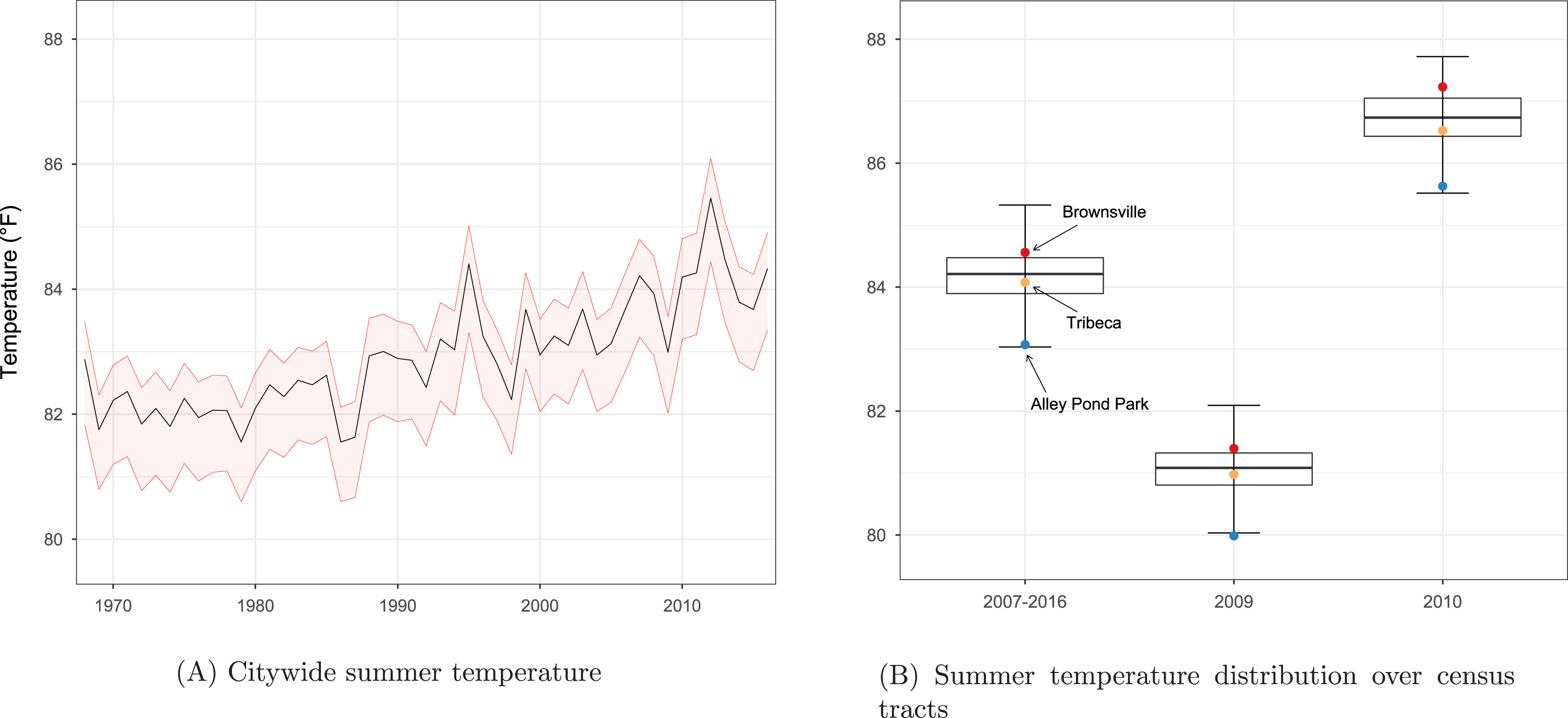
Fig1: Panel on the left depicts the 3-year moving average of the annual average daily maximum temperature in June, July, and August from 1966 to 2016. Panel on the right illustrates the distribution of summer temperatures for our sample period, 2007 to 2016, and for 2009, a relatively cold year, and 2010, an exceptionally hot year, and highlights temperature differences in three exemplary census tracts.
Citation: Borsky, S., Fesselmeyer, E., and Vogelsang, L. (2024) Urban heat and within-city residential sorting. Journal of Environmental Economics and Management, 127(2024): 1013014.